What is TruScore and how is it calculated?
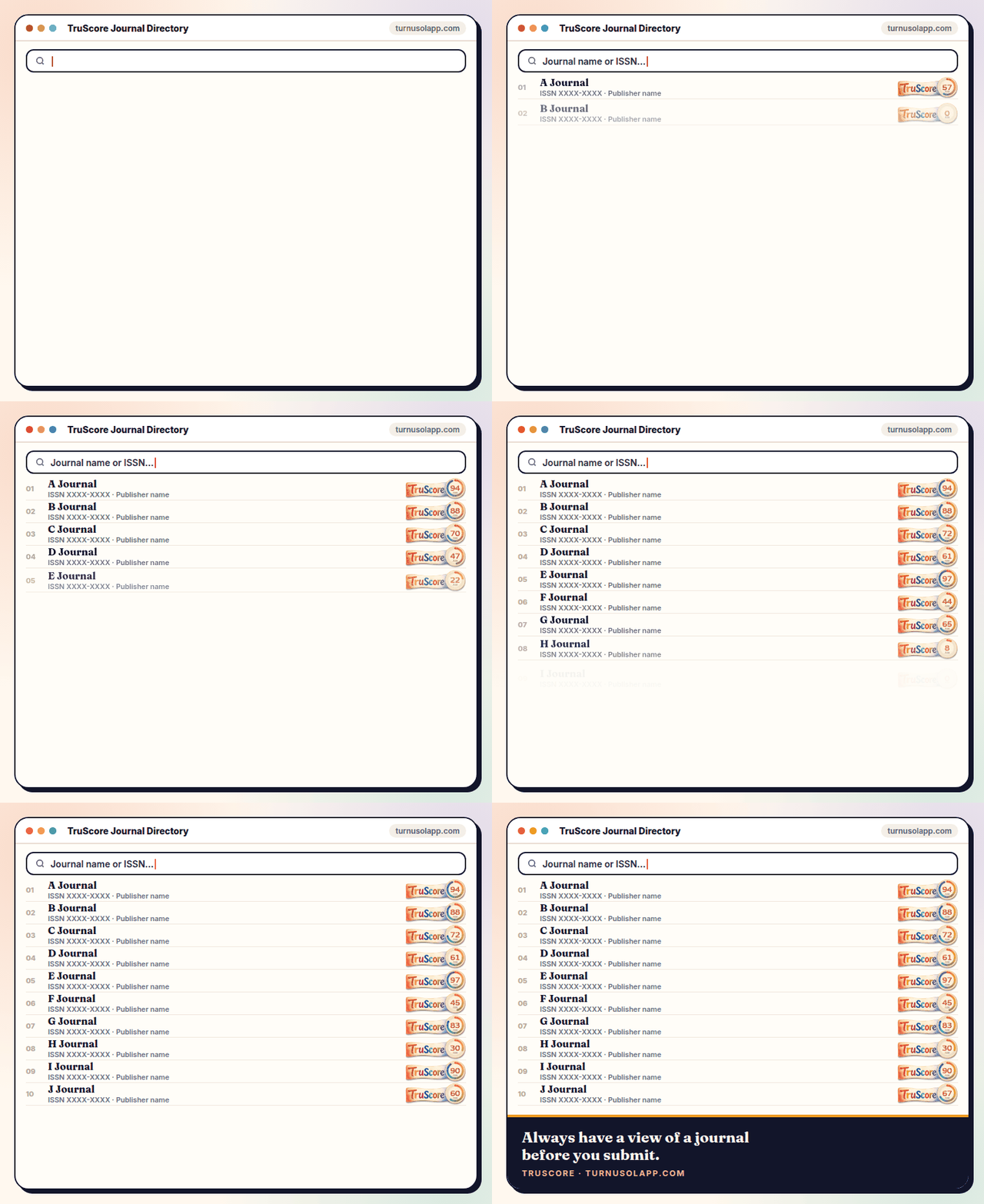
TruScore is a 0–100 score that evaluates an academic journal's registry, indexing and website evidence with fixed rules. A higher score means fewer warning signs were found in the sources checked. Its purpose is to let you see a journal's identity, records and what its website claims in one place — with sources — before you submit a paper.
TruScore is not a "good journal / bad journal" label; it summarises the evidence. Every finding that raises or lowers the score appears in the report with a link to where it came from or a quote from the journal's own page, so you never have to take the number on trust — you can open and check each finding yourself.
How to read a TruScore
Treat the score as a starting point. A high TruScore shows that the journal is consistent with the official records and that no notable warning signs were found in the sources checked; you should still check your institution's indexing requirements and the norms of your field. A low TruScore means you should read the report in detail: the findings that lowered the score are listed, with sources, under "Warning signs".
The date of the analysis is shown next to the score. Journals can change over time, so it is worth refreshing an older analysis before you decide.
Principles
- Every journal starts from a neutral point. Verified positive records (e.g. ISSN registration, DOI deposits, index memberships) raise the score; evidenced warning signs lower it.
- Missing information never lowers the score. Not finding a policy or record only lowers the confidence of the analysis, because the information may sit on a page that could not be scanned.
- Every finding that lowers the score rests on concrete evidence: a quote from the journal's own page, a registry record or a link. An impression without evidence is never scored.
- Minor signals (e.g. using only free webmail addresses) have a capped total effect and cannot change the outcome on their own.
- Index and membership checks use exact matches on the ISSN or the registry publisher name. A missing match in a name search is never treated as "not a member", and a similarly named journal is never attributed to this one.
- The rules are the same for every journal and are versioned; the same evidence always produces the same score.
Sources checked
- Identity: the ISSN Portal record, and whether the journal's title and website match it. Hijacked (cloned) journal sites usually diverge exactly here.
- Infrastructure: DOIs registered with Crossref, OpenAlex coverage, a secure connection (HTTPS) and the age of the domain (RDAP).
- Indexes and memberships: DOAJ, COPE and OASPA records. Each organisation reviews journals against its own criteria; a record shows the journal passed that review.
- Transparency: peer review, fee, licence, ethics, retraction and archiving policies and editorial board information published openly on the site.
- Integrity checks: the Retraction Watch hijacked-journal list, level X of the Norwegian Register for Scientific Journals (the level the register uses for journals whose approval is uncertain), removal from DOAJ or Scopus, the site's index and membership claims compared with the registries, whether DOIs shown on the site really belong to this journal, consistency of the address country with the ISSN record, and verification of editorial board members in scholarly records.
- Publishing profile: the balance between output volume and citations, sudden volume spikes, retraction counts and retraction reasons (OpenAlex, Crossref, the Retraction Watch Database) and the diversity of authors' institutions (the Norwegian Register's criterion: at most two thirds of the authors from one institution).
- Scope fit: whether articles in recent issues match the journal's declared field.
Strongest warning signs
The findings that lower the score most are: the site being on the Retraction Watch hijacked-journal list, the journal being listed at level X in the Norwegian Register, a domain that differs from the one in the ISSN record, fake or misleading impact metrics (e.g. SJIF, UIF), guaranteed acceptance or very fast publication promises, indexing claims the registries contradict (e.g. PubMed, Scopus, DOAJ), and removal from DOAJ or Scopus for quality reasons. Each of these appears in the report with a link to the page or record where it was found.
What is in a report?
- Source verification: ISSN, DOAJ, Crossref, OpenAlex, COPE, OASPA, Retraction Watch and the Norwegian Register row by row, each with a link to its source.
- Warning signs and positive signals: the findings that affect the score, with their evidence.
- Cloned-journal check: the site compared with the official address in the ISSN record and with known hijacked-journal lists.
- Think. Check. Submit. checklist: the items of the international checklist, split into verified and unverifiable.
- Recent issues and scope: articles in the latest issues and how well they fit the declared field.
- Librarian's commentary: a short summary built on the report's evidence, what to check by hand before submitting, and recommendations for journal editors.
- Community discussions: forum and web posts that name the journal by its full title or ISSN (not scored).
What is not scored
- Third-party allegations: doubts and allegations on forums, Reddit and web pages that name the journal by its full title or ISSN are listed in the report with their links, but as unverified statements they are not reflected in the TruScore. They are there for you to read and weigh.
- AI: AI only writes the librarian summary of the report; it neither calculates nor changes the score. Every sentence of the summary is tied to evidence in the report, and sentences without supporting evidence are removed automatically.
- For journals that describe themselves as multidisciplinary, scope fit cannot be measured and is not scored.
Who is it for?
TruScore is built for researchers who want to check a journal before submitting, librarians who guide students and faculty, institutions that assess journals for publication incentives and promotions, and journal editors who want to see whether their journal's records appear correctly.
How current is the data?
Every analysis scans the journal's website and the registries afresh at the time it runs, and the report is stored with its date. Hijacked-journal lists and DOAJ records are refreshed regularly. When a journal is analysed again, the result is recalculated from the new evidence.
Limits
TruScore is an automated analysis and does not replace your institution's indexing requirements or your own judgement. Some sites block automated scanning; some information may then be missing and the confidence of the analysis drops, but the score is not lowered for that reason. Scopus and Web of Science verification is coming soon. Publishers who believe a result is wrong can use the Publisher dispute form under the report; disputes are reviewed and the report is updated when needed.
Scoring rules version: 2.0. See the demo report for every section of a report.